6:5 vs 3:2 blackjack: how one fraction moves the house edge
A blackjack table that pays 6:5 gives you €12 for a €10 natural blackjack (an ace plus a ten-value card as your first two cards), where a 3:2 table gives you €15. That €3 shortfall costs about 1.36% of every bet you place, so a game with a 0.43% house edge at 3:2 runs at roughly 1.79% at 6:5.
Nothing else changes when a casino swaps the payout. Same decks, same dealer rules, same strategy chart. I recomputed the cost from first principles below, because it is one of the few numbers in blackjack you can derive with a pencil, and seeing the derivation makes it much harder for a felt sign to talk you out of it. The dollar version is identical: swap € for $ throughout.
What do 3:2 and 6:5 mean on a blackjack table?
The ratio is the payout on a natural only. At 3:2 you win 3 units for every 2 staked, so a natural returns 1.5 times your bet. At 6:5 you win 6 for every 5, which is 1.2 times your bet. Every other winning hand still pays 1:1, and insurance still pays 2:1.
On a €10 / $10 bet that is €15 versus €12. On a €25 bet it is €37.50 versus €30. The gap is always 0.3 times your stake, and it only appears on the hands where you are dealt a natural and the dealer is not.
6:5 is a smaller payout, not a bigger one
How often are you dealt a natural blackjack?
About once every 21 hands. Here is the arithmetic for an eight-deck shoe of 416 cards, which holds 32 aces and 128 ten-value cards (tens, jacks, queens and kings).
- Ace first, then a ten-value card: 32/416 × 128/415
- Ten-value card first, then an ace: 128/416 × 32/415
- Add the two orders: 2 × 32 × 128 ÷ (416 × 415) = 8,192 ÷ 172,640 = 4.745%, or 1 in 21.07
A natural only gets paid if the dealer does not also have one. If both of you hold blackjack, the hand is a push and the payout ratio never comes into play. With your ace and ten already out of the shoe, the dealer’s chance of a natural from the remaining 414 cards is 2 × 31 × 127 ÷ (414 × 413) = 4.605%. So the share of hands where you collect a blackjack payout is 4.745% × (1 − 0.04605) = 4.527%, about 1 in 22.
Deck count barely moves this. Fewer decks make naturals slightly more likely, because removing one ace from a single deck changes the odds of the next card more than removing one from eight decks.
| Decks | Chance of a natural | Paid naturals (dealer has no natural) | Cost of 6:5 vs 3:2 |
|---|---|---|---|
| 1 | 4.827% (1 in 20.7) | 4.649% | 1.39 points |
| 2 | 4.780% (1 in 20.9) | 4.578% | 1.37 points |
| 6 | 4.749% (1 in 21.1) | 4.532% | 1.36 points |
| 8 | 4.745% (1 in 21.1) | 4.527% | 1.36 points |
What is the house edge at 3:2? The baseline
For a reference game I used the Atlantic City rule set that Michael Shackleford works from on Wizard of Odds: dealer stands on soft 17, you can double any two cards, double after a split and split up to four hands. He puts the house edge for a basic-strategy player at 0.43%. That is a good game. Over a long run, a perfect basic-strategy player loses 43 cents per €100 bet.
Every other figure in this article is built on that 0.43%. If your table hits soft 17 or bans doubling after a split, the baseline is a little higher, but the 6:5 penalty sits on top of it in the same way.
How to calculate what 6:5 costs per hand
The method is three steps, and you can redo it for any payout.
- Find the payout gap. 3:2 pays 1.5 units, 6:5 pays 1.2. The difference is 0.3 units per paid natural.
- Multiply by how often it happens. 0.3 × 4.527% = 0.01358 units per hand, or 1.36% of your average bet.
- Add it to the baseline. 0.43% + 1.36% = 1.79%. The house edge goes up roughly fourfold.
Wizard of Odds lists the 6:5 penalty as 1.39%. My recompute gives 1.36% for six or eight decks and 1.39% for a single deck, so the figures agree once you match the deck count. Three hundredths of a point either way changes nothing about the conclusion.
The worked example: 1,000 hands at €10
Put real money through it. Over 1,000 hands at €10 a hand you stake €10,000 in initial bets on an eight-deck shoe.
| Step | Pays 3:2 | Pays 6:5 |
|---|---|---|
| Naturals dealt to you | 47.5 | 47.5 |
| Pushed against a dealer natural | 2.2 | 2.2 |
| Paid naturals | 45.3 | 45.3 |
| Win per paid natural | €15 | €12 |
| Total blackjack winnings | €679 | €543 |
| Expected loss on €10,000 staked | €43 | €179 |
The €136 difference between the two blackjack totals is 1.36% of €10,000. You could play the identical 1,000 hands with the identical decisions and hand the casino an extra €136 simply by sitting at the wrong table.
At a live table dealing around 80 hands an hour, that becomes an hourly figure. Eighty hands is an assumption; a full table is slower, a heads-up game or an online table is faster, so scale it to your own pace.
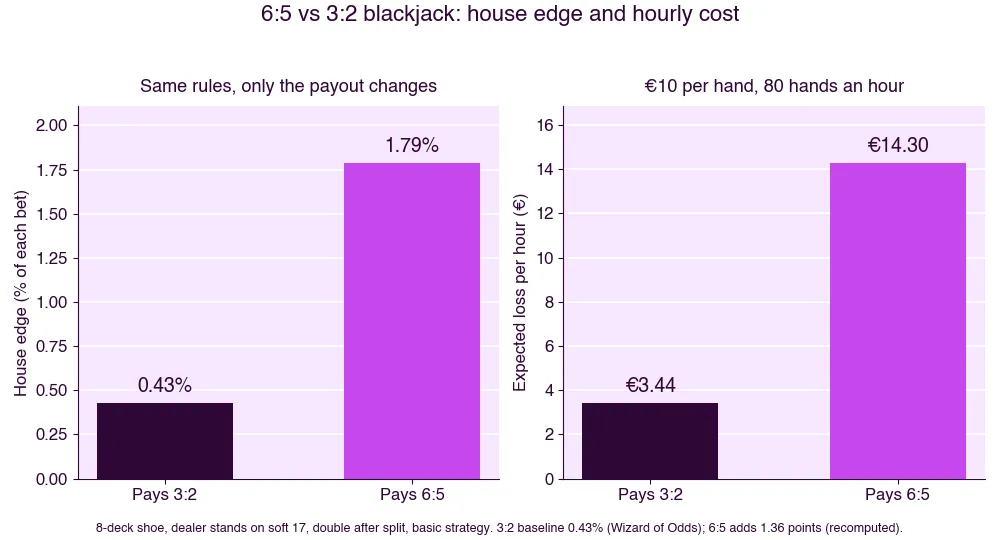
At 3:2 you stake €800 an hour and expect to lose €3.44. At 6:5 it is €14.30. You are short-paid on about 3.6 naturals an hour, €3 each, which is the €10.86 gap. Over a four-hour session that is €13.76 against €57.20.
Why does this one rule matter more than the others?
Because most rule changes are measured in tenths of a point and this one is measured in whole points. On the same Wizard of Odds rule-variation table, the dealer hitting soft 17 costs you 0.22%. Losing double after split costs 0.14%. Going from eight decks to a single deck is worth 0.48% in your favour. The 6:5 payout outweighs all of those put together.
That is also why a single-deck 6:5 game is a worse deal than it sounds. Single deck is the most player-friendly deck count there is, yet adding the 0.48% single-deck gain and the 1.39% 6:5 penalty to the 0.43% baseline gives roughly 1.34%. Treat that as an approximation, since rule effects do not add up perfectly, but it lands more than three times higher than an ordinary six-deck 3:2 shoe at about 0.41%.
The same arithmetic covers the other short payouts. A 7:5 table is 0.1 units short, which costs about 0.45%. Even money on naturals is 0.5 units short, about 2.26%.
No strategy closes the gap
There is one decision the payout does flip. When you hold a natural and the dealer shows an ace, you may be offered even money: a guaranteed 1:1 instead of waiting to see if the dealer has blackjack. At 3:2, declining is worth about 1.04 units on average, so you should turn it down. At 6:5, declining is worth only about 0.83 units (a 69% chance of collecting 1.2), so if the table offers a flat 1:1, taking it is the better play. Regular insurance is a different bet and still loses money at either payout.
How to spot which payout a table uses
At a land-based table, the payout is usually printed across the felt, often in the line that reads something like “Blackjack pays 3 to 2”. Read it. If the felt does not say, look for the table placard. If neither says, ask the dealer before you buy in. Shackleford’s advice on Wizard of Odds is the same: check the felt, then the sign, then ask.
Online, open the game’s rules or help screen. In Great Britain, the Gambling Commission’s remote technical standards (RTS 3) require licensed sites to make the payouts, plus the house edge, RTP or probability of winning, easily available before you commit to a bet. That makes the help screen the place to confirm the blackjack payout. For scale, the good-rules game in this article returns about 99.57% at 3:2 and about 98.21% at 6:5, so a stated RTP well under 99% is worth a closer look at the rules.
If you clear casino bonuses on blackjack, bear in mind that table games often count for only a fraction of each bet towards the requirement; our guide to how wagering requirements work walks through that weighting. A 6:5 game makes that slower route more expensive still.
The short version before you sit down
- 3:2 pays 1.5x on a natural, 6:5 pays 1.2x. The difference is 0.3 of your bet each time.
- You are paid a natural about once in 22 hands once you remove the ones that push against a dealer blackjack.
- 0.3 × 4.53% = 1.36 points of house edge on six or eight decks, 1.39 on a single deck.
- On a 0.43% game, that is 1.79%. At €10 a hand and 80 hands an hour, €3.44 an hour becomes €14.30.
- No strategy or system wins it back. The only fix is choosing a 3:2 table.
Neither table pays you to play over time; one is just far cheaper. If you want to set a firm limit on what a session can cost before it starts, run the figures through the bankroll calculator above, and if blackjack has stopped being something you play for fun, our responsible gambling page lists where to get support. 18+.
Frequently asked questions
Is 6:5 blackjack worse than 3:2?
How much does 6:5 blackjack cost per hour?
Does basic strategy change at a 6:5 table?
Is single-deck 6:5 blackjack a good game?
What about 7:5 or even-money blackjack payouts?
How often do you get blackjack?
Sources
- Wizard of Odds (Michael Shackleford) — Blackjack basics: rule variations, 6-5 payout effect, Atlantic City house edge — Baseline 0.43% and rule-variation figures
- UK Gambling Commission — RTS 3: Rules, game descriptions and the likelihood of winning — Payouts and house edge/RTP must be available before play

5+ Years in iGaming, Co-founder and Editor of BrilliantCasinos.com.
More from Roberts Terehovics